AI for Lawyers: Contract Analysis and Legal Research
A workshop for lawyers who want to analyze contracts and conduct legal research faster while maintaining control over risk, ethics, and work quality.
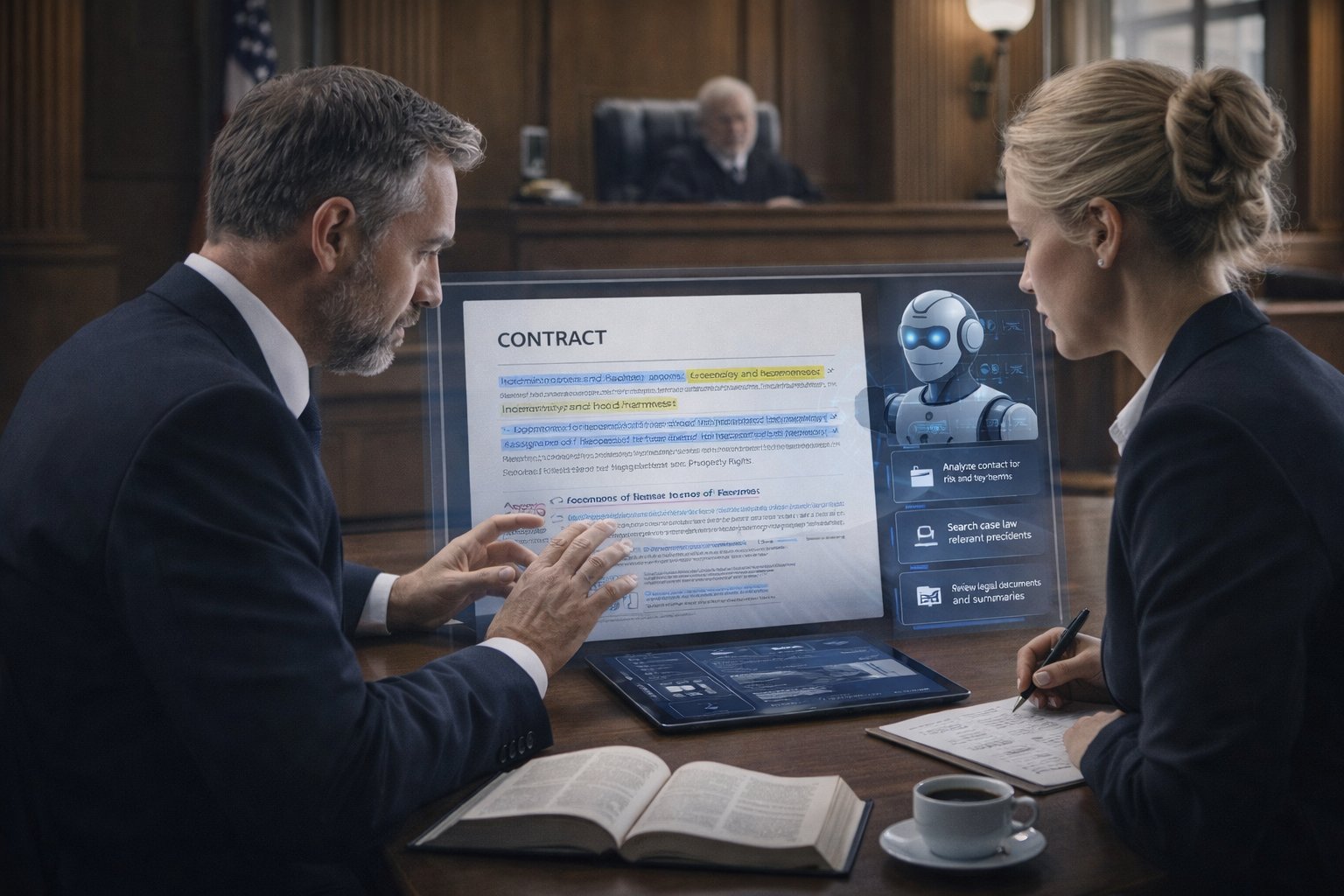
This four-hour workshop shows how to use AI in practice in two of the most time-consuming areas of a lawyer’s work: contract analysis and legal research. The program is built around the realities of law firms and legal departments: time pressure, professional responsibility, confidentiality, accountability, and the need to document the reasoning process. Participants will learn to recognize when AI truly speeds up work and when it increases the risk of error, overinterpretation, or violation of ethical standards. The course differs from general AI training in that it focuses on specific artifacts of a lawyer’s work: red flags in contracts, checklists, comparisons of weak and strong prompts for AI, a legal research note, verification of claims, and decisions about what can be delegated to a tool and what must remain within professional judgment. The program takes into account current market trends: AI is now seen as the strongest force changing the legal profession in the coming years, 80% of law firm respondents expect a significant change in how firms operate, and the main barriers to implementation remain data privacy, security, and the lack of a visible strategy. Thomson Reuters also indicates that the applications most often rated as most useful for lawyers are legal research, document summarization, document review, and contract work, with a simultaneous emphasis on human oversight, fact-checking, and compliance with professional ethics rules.
What you will learn
- Assess which tasks in contract analysis and legal research are worth supporting with AI and which require full expert work without delegation.
- Prepare effective prompts for clause analysis, risk identification, document summarization, and organizing material for research.
- Use checklists to verify AI responses for legal accuracy, completeness, sources, timeliness, and professional risk.
- Detect typical AI errors in legal work, including excessive confidence in answers, omission of exceptions, incorrect generalization, and seemingly credible reasoning.
- Conduct an analysis of a real contract with AI support and prepare a short, useful recommendation for a client or business.
- Use AI to prepare legal research faster without losing the standard of verification and professional responsibility.
- Establish rules for safe AI use in a law firm or legal department: confidentiality, oversight, work documentation, and legal ethics.
- Plan a small AI implementation in legal practice with metrics for efficiency, quality, and risk reduction.
Prerequisites
Basic experience working with contracts or legal research, familiarity with the document review process, and readiness to work hands-on with examples. No technical knowledge is required.
Course syllabus
- How the Lawyer’s Work Is Changing: Contract Review and Research as the Two Fastest Areas of Return
- Which tasks are worth speeding up, and which must not be handed over without full verification
- What Is the Client Really Buying: Speed, Cost Predictability, or Better Argumentation Quality
- Quiz: Identifying High-Value and High-Risk Tasks
- How to Read a Contract with AI Without Losing Legal Judgment
- Weak and strong prompts: comparing two ways of asking to detect risks in clauses
- Case study: analysis of a real commercial agreement and a list of red flags
- How to turn an analysis result into a short recommendation for management or a client
- Checklists for Verifying AI in Contract Review
- Quiz: which risks are real and which only sound convincing
- From Client Question to Research Plan: How to Define a Legal Problem Well
- Before and after: a research note prepared chaotically versus organized with the help of AI
- How to verify claims, exceptions, and the currency of material before it goes into a legal opinion
- Case study: research for a dispute or internal opinion under time pressure
- Quiz: recognizing seemingly credible answers
- Legal ethics in the use of AI: responsibility, confidentiality, and the limits of delegation
- Minimal Safety Rules for a Law Firm and Legal Department
- How to launch a small pilot: choosing matters, quality metrics, and ROI assessment
- Final quiz: implementation decisions in legal practice
FAQ
For attorneys, legal advisers, trainee lawyers, in-house lawyers, and people supporting the work of legal departments and law firms who want to use AI in practice — especially in contract analysis and legal research.
The participant will learn to assess when AI truly saves time and when it increases the risk of error, overinterpretation, or violation of standards. The course shows how to work with AI when reviewing and comparing clauses, identifying risks, organizing research material, and documenting the workflow in a professionally useful way.
Practical. The program is built around the realities of law firms and legal departments: time pressure, professional responsibility, confidentiality, accountability, and the need to justify conclusions. Participants work on scenarios close to a lawyer’s everyday work.
Because the legal market is rapidly moving from experimentation to everyday use of AI. According to the latest industry reports, adoption of generative AI in legal organizations is growing, and professionals report time savings — while issues of human oversight, source quality, data privacy, and responsibility for outcomes are increasingly emphasized.
Yes. This is one of the key elements of the workshop. Participants learn to identify which tasks can be delegated to AI, how to minimize the risk of data disclosure, how to work carefully with sensitive material, and how to maintain control over the final result.
The course takes the form of a four-hour workshop designed to translate knowledge into concrete applications in legal work in a short time.
Faster contract analysis, more efficient legal research, better recognition of AI tool limitations, and greater confidence that technology supports professional standards rather than undermining them. This is training for lawyers who want to use AI wisely, not just because it is trendy.
- 4 hours
- Intermediate
- Certificate on completion
- Access immediately after purchase