Will AI take my job? It’s better to ask a different question
Fear of AI is understandable, especially when you’re working, managing a home, and trying to keep up with change. But the real issue is not just “will AI take my job?”, but rather: which tasks will disappear, which will stay, and how can you learn to work with tools before others do?
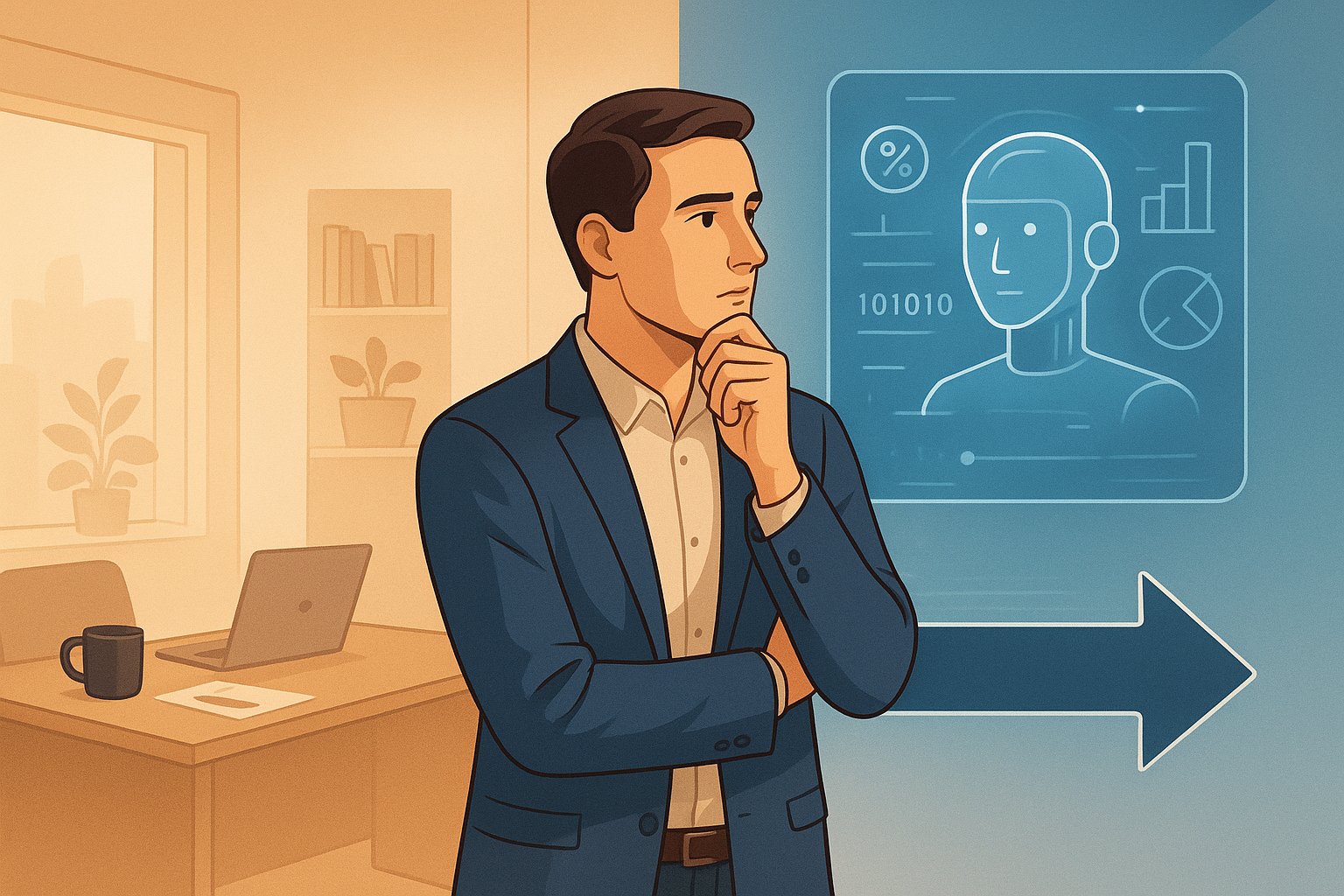
The question “will AI take my job?” comes up regularly these days. Sometimes it appears after reading a headline about automation, sometimes after talking to a friend who “does everything with ChatGPT,” and sometimes late in the evening, when after work you still have to handle the kids, shopping, and overdue emails. At moments like that, it’s easy to conclude that the world has sped up a little too much.
This is not an exaggerated fear. The change is real. Some tasks really will disappear or be done faster, cheaper, and with less human involvement. But that does not automatically mean that all human work will disappear. Usually, a fragment of a process disappears, not an entire profession.
So the better question is not: will AI take my job?, but: which parts of my work can be automated, and which will become even more valuable?
AI rarely takes an entire profession. More often, it takes repetitive tasks
In debates about artificial intelligence, two different things are often mixed together: a job title and a set of tasks. That distinction matters.
For example, a marketing specialist does not do just one thing. They write copy, analyze campaign results, talk to clients, plan activities, coordinate designers, fix presentations, look for ideas, and put out fires. AI can help with some of these tasks, but it does not replace the full context, responsibility, and decision-making.
The same is true in administration, HR, sales, customer service, and education. AI tools are great at:
- organizing information,
- creating first drafts of texts,
- summarizing documents,
- analyzing large data sets,
- generating ideas,
- automating simple responses.
But they perform much worse where what matters is:
- understanding nuance,
- responsibility for a decision,
- relationship with another person,
- risk assessment,
- knowledge of the realities of a company or industry,
- knowing when a “good answer” on screen is, in practice, a bad answer.
That is exactly why in many professions the winner will not be the person who “knows AI,” but the one who can sensibly combine AI with their own experience.
The biggest risk does not affect everyone equally
Not every job is threatened to the same degree. The most vulnerable to automation are tasks that are predictable, schematic, and based on repetitive patterns. If something can be described by step-by-step instructions and does not require much responsibility for context, AI has a lot of room to operate.
That does not mean that people doing such tasks are “less needed.” It only means that the market will start expecting more from them than before. Instead of simply carrying out instructions, it will become increasingly important to:
- formulate the problem correctly,
- check the quality of the result,
- correct errors,
- combine information from different sources,
- make decisions based on AI recommendations.
In other words: less mechanical clicking, more thinking about the goal.
For many people, that is good news, even if at first it sounds like extra work. If you have spent years working mainly operationally, stepping into the role of an “AI-assisted process operator” may feel a bit uncomfortable. But that is exactly the move that increases job security.
What really gives you an advantage in the job market
A lot of myths have grown up around AI. One of them says you need to immediately become a half-programmer, know all the models, shortcuts, and latest trends. For most working adults, that is simply unrealistic. And unnecessary.
In practice, four things give you an advantage today.
1. The ability to ask good questions
It sounds trivial, but this is exactly where many people lose to tools before they even start using them. If you type into ChatGPT: “write something about our offer,” you’ll get an answer that is correct, but often generic. If you specify the target audience, tone of communication, purpose of the text, constraints, and examples, the result will be much better.
The difference between a weak and a good prompt is often the difference between:
- wasting 20 minutes,
- and saving 2 hours.
The good news is that this does not require a technical education. It is more a matter of thinking, precision, and practice than “secret knowledge for insiders.”
2. Critical evaluation of AI responses
AI can sound confident even when it is wrong. Sometimes it will provide outdated information, sometimes it will invent a source, and sometimes it will create an answer that sounds logical but is completely off for a given situation.
That is why the valuable person is not the one who blindly copies the output, but the one who knows how to ask:
- does this make sense in my industry?
- what is missing here?
- what needs to be checked manually?
- does this answer take into account the realities of my company, client, and team?
The more responsibility a job carries, the more important this skill becomes.
3. Combining industry knowledge with AI
A language model may know thousands of patterns, but it does not know your company the way you do. It does not know what the document approval process really looks like, what your clients are afraid of, how your boss reacts to risky ideas, or which solutions “on paper” will never get approved.
That means that simply using the tool is not enough. What matters is combining two things:
domain knowledge + the ability to work with AI.
If you work in sales, HR, education, administration, marketing, or customer service, your understanding of people, processes, and organizational constraints is still a huge asset. AI does not erase that advantage. It strengthens it, if you know how to use it.
4. Willingness to learn in small steps
Many people get stuck because they think of AI as a huge project: you have to sit down, dedicate a weekend, understand everything, and implement it right away. Life usually looks different. Between work and home, it is hard to find even one quiet hour.
That is why a practical approach is better:
- today I’ll learn to write better prompts,
- tomorrow I’ll test AI for emails,
- next week I’ll see how it helps with research,
- then I’ll assess what really saves me time.
You do not need to become an expert in everything. It is enough to become someone who regularly improves the way they work.
What to fear less, and what to fear more
Contrary to appearances, the biggest threat is not AI itself. Often the bigger problem is the chaos around it.
It is worth fearing the fact that these tools exist less. They are here to stay. There is no point in getting offended at a calculator, spreadsheet, or search engine just because they changed the way we work. AI will be similar.
It is worth fearing three things more.
First: passivity. If for a year you check nothing, test nothing, and only observe, you may wake up at a moment when others are already working faster and with more confidence.
Second: apparent competence. This is the situation where someone “uses AI,” but in practice throws in any old prompt, takes the first answer, and considers the matter solved. That kind of work looks modern, but often ends in poor results.
Third: handing responsibility over to the tool. AI can support a decision, but it should not make it thoughtlessly for you. Especially where people, money, law, or reputation are involved.
How to check whether your work is vulnerable to change
Instead of guessing, it is worth doing a simple audit of your own tasks. Take a sheet of paper or a notebook and write down what you do in a typical week. Then divide it into three groups.
Tasks that AI can speed up
For example:
- writing first drafts of emails,
- meeting summaries,
- research and organizing information,
- creating outlines, plans, and checklists,
- improving the language of a text,
- generating ideas.
Tasks that require your oversight
These are things where AI can help, but should not act on its own:
- communication with clients in sensitive matters,
- risk analysis,
- preparing important documents,
- personnel decisions,
- interpreting data in a business context.
Tasks that AI is unlikely to replace soon
These are usually areas connected with relationships, responsibility, and experience:
- negotiations,
- building trust,
- resolving conflicts,
- leading a team,
- teaching others,
- making decisions with incomplete data.
This simple review can be reassuring. Suddenly it turns out that your work is not one monolith, but a set of elements. Some can be improved. Some need to be supervised. Some remain very human.
If you feel “behind,” you are not an exception
Many people today feel that everyone else already knows how to use AI, and they are the ones left behind. This is a feeling well known from social media and office coffee-break conversations. Someone shows one clever trick and suddenly it looks like they have an unbeatable advantage.
The truth is much less dramatic. Most people are still at the stage of trial, error, and half-working methods. They use tools, but often do not know how to get a truly good result from them. That is exactly why learning the basics matters so much, not just random experimentation.
Where to start so you don’t get stuck in theory
The best place to start is one specific use case. Not “I’ll learn all of AI,” but a problem that repeats in your work week.
It could be:
- writing difficult emails,
- preparing meeting notes,
- creating a presentation outline,
- organizing information from several documents,
- coming up with topics for posts or materials,
- improving the quality of texts.
Choose one task and see whether you can do it faster or better with AI. If so, only then move on. That is how real competence is built, not a collection of fun facts.
Where it really pays to learn how to work with ChatGPT
If you want to use AI sensibly, at some point “just clicking around and seeing what happens” stops being enough. Especially when you use the tool for work, not just for fun. Then it is not the number of attempts that matters, but the quality of the approach.
A good step for non-technical people is a workshop that shows how to talk to the model so that the answers are useful, not random. That is why it is worth paying attention to the course Prompt Engineering – The Art of Talking to ChatGPT.
It is a sensible option especially for working people who do not have time to dig through technical jargon, but want to quickly improve the quality of their work with AI. The course teaches how to:
- write better prompts for everyday personal and professional tasks,
- evaluate the quality of answers,
- improve results step by step,
- use ChatGPT consciously, not by guesswork.
For someone worried about their professional future, this is not a “nice extra.” It is a practical investment in a skill that pays off immediately: in emails, documents, research, planning, and communication. Instead of guessing how to talk to AI, you learn it in a structured way. And that usually shortens the path by many failed attempts.
Will it be harder without AI in a few years?
Most likely yes. Not because every employee will be replaced, but because the standard of efficiency will change. Just as it once became natural to use office software, messengers, or search engines, the ability to work with AI will become equally natural.
Employers will increasingly expect that you:
- can speed up simple tasks,
- can prepare a better starting material,
- know how to check the quality of AI responses,
- are not afraid of new tools.
That does not mean everyone will add “AI expert” to their CV. Rather, it means that lacking the basics will start to feel like lacking confidence with a computer does today.
The most sensible strategy for today
Do not panic. Do not ignore it. Learn practically.
If you have the fear in your head that AI will take your job, treat it not as a verdict, but as a signal. Maybe now is the right time to look at your own tasks and build a skill that increases your value.
Because the market usually does not reward the most frightened or the most dazzled by new trends. It rewards those who can adapt to change sensibly.
And that means something very concrete: understand what AI is good for, learn how to talk to it, know how to evaluate the result, and keep on your side what is truly human.
That is still quite a lot. And honestly, that is good news.
Because the future of work does not belong only to AI.
It belongs to the people who know how to use it.