Will AI analyze a contract faster than a junior lawyer?
An investment agreement reviewed in 10 minutes instead of 2 hours? It’s possible, but only when AI works like a well-configured assistant, not an oracle. See where it really saves time in contract analysis, where it can make mistakes, and how to implement it in a lawyer’s workflow without losing control over risk.
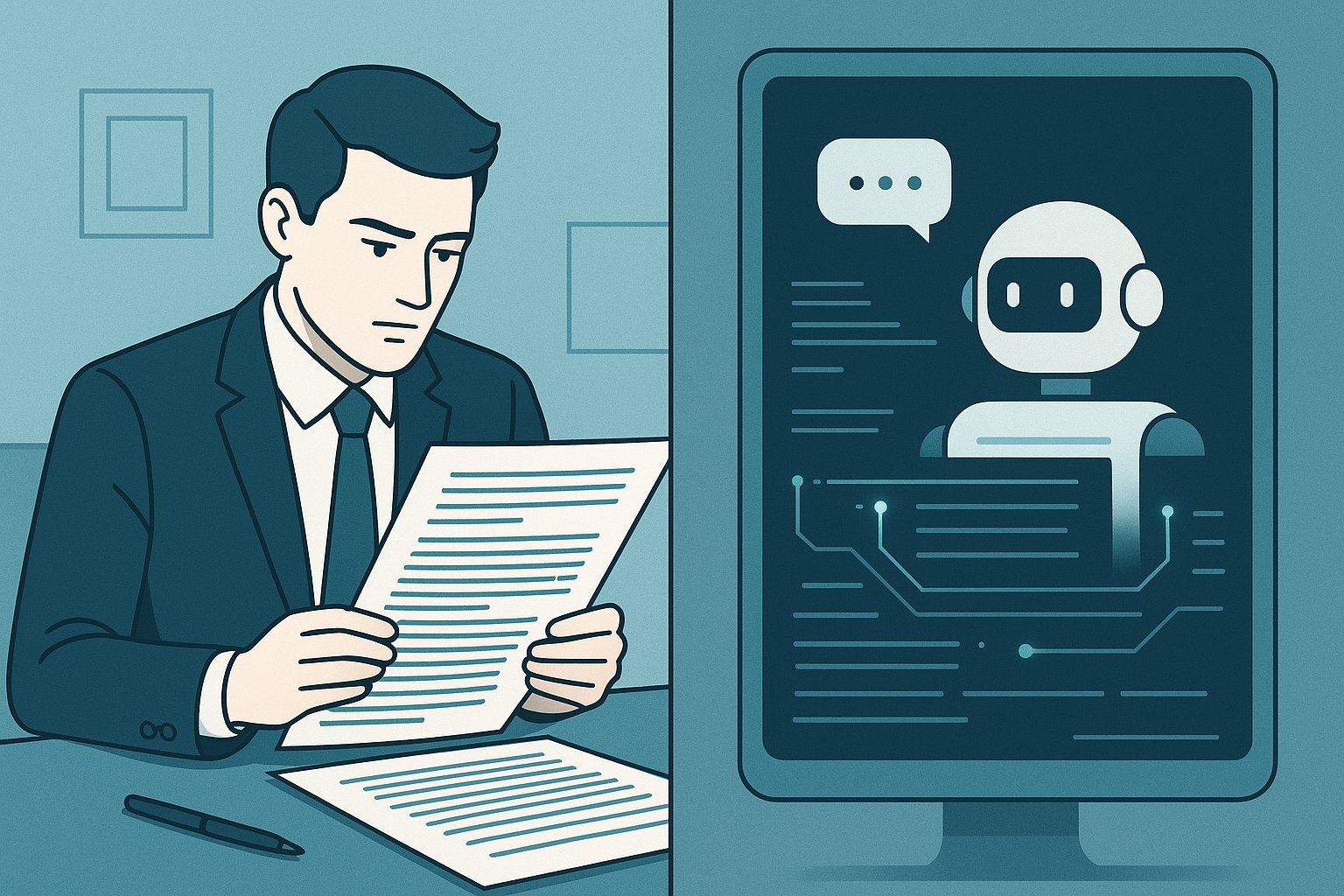
The first scene is quite familiar. Friday, 4:40 p.m. An investment agreement draft lands in the inbox with the comment: “we need initial feedback by today.” The document is several dozen pages long, with a few appendices, the classic set: liquidation preference, anti-dilution, drag along, tag along, warranty package, conditions precedent. The junior sits down to read, marks risks, compares definitions, checks inconsistencies. After two hours, they have a solid first version of notes.
Now the second scene. The same document goes to a lawyer who uses AI as a working tool. Within 10 minutes, they get:
- a list of key clauses,
- identification of non-standard provisions,
- detected inconsistencies in definitions,
- questions for the client,
- a draft risk checklist for further verification.
Sounds like marketing? A little. But only a little. Because the truth is more interesting: AI really can speed up contract analysis faster than a junior lawyer, just not in the way many people imagine.
It’s not about the model “understanding the contract like an experienced counsel.” It’s about it being able to rapidly do part of the work that takes lawyers the most time in practice: organizing content, spotting patterns, summarizing, comparing versions, and building lists of risks and questions. And that already makes a difference.
Where AI really beats a junior
If we compare AI and a junior lawyer in the task “read the document and prepare a first risk map,” the tool’s advantage is immediately visible.
First: speed. The model doesn’t get tired on page 37, doesn’t lose focus after the third definition of “Material Adverse Effect,” and doesn’t need coffee to notice that a deadline in an appendix doesn’t match the deadline in the main body.
Second: consistency. A well-prepared prompt lets you analyze successive contracts using the same scheme. This is especially important in in-house legal teams, where review consistency and process predictability matter.
Third: breadth of the first review. A junior usually reads linearly. AI can work on several layers at once:
- summarize the document,
- extract high-risk clauses,
- identify missing provisions,
- suggest negotiation questions,
- prepare a “provision – risk – recommendation” table.
That doesn’t mean AI “thinks better.” It only means that at the first screening stage it can be unbeatable.
What can be done in 10 minutes, and what still requires a lawyer
In practice, a simple division works best.
Tasks AI accelerates very strongly
- summarizing a contract in business language,
- identifying key clauses,
- comparing two versions of a document,
- detecting inconsistencies in definitions and deadlines,
- creating a risk checklist,
- preparing questions for the client or the other side,
- preliminarily marking sections requiring negotiation.
Tasks you should not hand over to AI without supervision
- assessing compliance with the client’s specific factual situation,
- interpreting in the context of transaction strategy,
- choosing negotiation arguments,
- assessing litigation and regulatory consequences,
- the final “accept / reject / renegotiate” recommendation.
In other words: AI is excellent at pre-review, but it does not replace legal judgment. And that’s a good thing. The client doesn’t pay for someone to read a document quickly. They pay for an accurate risk assessment.
Case study: an investment agreement in 10 minutes instead of 2 hours
Let’s take a concrete example. A law firm receives a draft investment agreement for a technology company raising seed funding. The goal: prepare an initial list of comments for the founders the same day.
The classic workflow looks like this:
- the lawyer reads the whole document,
- marks critical clauses,
- compares them with market standards,
- checks definitions and dependencies between provisions,
- prepares a note for the client.
Time: around 1.5–2 hours for the first review.
An AI-assisted workflow can look different.
First, the lawyer uploads the document to a secure environment or works on an anonymized excerpt. Then they give the model a few precise instructions:
- “List the clauses that have the greatest impact on dilution and corporate control.”
- “Identify provisions that deviate from founder-friendly market standards.”
- “Compare the investor protection mechanisms with the founders’ interests.”
- “Prepare a table: clause, risk, business consequence, question for the client.”
After a few minutes, they get working material. Not a legal opinion. Not a ready-made recommendation. But a very good starting point.
The result? Instead of spending the first hour painstakingly extracting the document’s structure, the lawyer immediately moves to what really requires experience:
- whether the liquidation preference is economically acceptable,
- whether the veto rights are proportionate,
- whether anti-dilution goes too far,
- whether founder vesting matches the company’s reality,
- which provisions will be problematic in future rounds.
And that’s where the practical advantage appears. AI shortens the path to the real legal work.
But there’s a catch: hallucinations and false confidence
Every lawyer who has worked with a language model for more than 15 minutes knows one thing: AI can sound convincing even when it is wrong.
That is the biggest risk. Not just “inventing” statutes or case law — though that happens too — but a false sense of correctness. The model will write elegantly, logically, with good structure. The problem is that elegant nonsense is still nonsense.
In contract analysis, hallucinations usually take several forms:
- the model assigns a clause a legal effect that is not in the text,
- it omits an important exception written a few paragraphs later,
- it oversimplifies the meaning of a provision,
- it misinterprets the relationship between definitions,
- it suggests a “market standard” it cannot substantiate,
- it mixes legal systems or practices from different jurisdictions.
That is why the worst possible scenario looks like this: the lawyer treats the AI output as a finished analysis, copies the conclusions into an email, and sends it to the client. Fast? Yes. Sensible? Not necessarily.
How to verify AI results so you don’t create problems for yourself
The good news is that the risk can be managed. You just need to adopt a simple rule: AI prepares the material, the lawyer gives the assessment.
In practice, it’s worth implementing a few rules.
1. Force the model to work on source text
Don’t ask: “is this contract safe?” That invites vague answers. Better ask:
- “Identify the specific provisions that increase risk for the company and quote the relevant passages.”
- “Provide the clause number on which you base your conclusion.”
- “If something is not in the text, state that clearly.”
It’s a simple change, but it dramatically improves the quality of the work.
2. Ask for a table: provision, risk, basis, recommendation
This format quickly reveals whether the model is actually relying on the document or just “telling a nice story.” If it cannot point to a basis, the conclusion is suspicious.
3. Verify only what matters
You don’t need to manually check every sentence generated by AI. It’s enough to focus on critical elements:
- financial clauses,
- liability limitations,
- termination mechanisms,
- jurisdiction and governing law,
- representations and warranties,
- conditions precedent,
- breach sanctions.
4. Use AI for a second read, not only the first
A useful trick: after your own analysis, ask the model to find counterarguments or overlooked risks. It works surprisingly well. Not as an authority, but as a digital opponent that is obliged to nitpick.
5. Don’t upload data without thinking
If you work on documents covered by legal privilege, NDAs, or simply containing sensitive business data, security is not an add-on. It is a condition for using the tool.
You need to know:
- where the data goes,
- whether it is used to further train models,
- who has access to it,
- whether anonymization is possible,
- what rules the law firm or legal department has adopted.
It sounds unromantic, but that’s what professional AI implementation looks like. Less “magic,” more procedure.
Ethics: it’s not just about GDPR and legal privilege
In discussions about AI for lawyers, ethics is often reduced to the question: “can I paste a document into the tool?” That’s important, but not the only issue.
Quality and accountability are equally important.
If a client receives an analysis prepared partly with AI assistance, responsibility still rests with the lawyer. Not the model, not the tool provider, not the “system.” The lawyer signs the opinion with their name and reputation.
There is also the problem of overtrust in automation. The better the answer sounds, the easier it is to stop asking uncomfortable questions. And those questions are exactly what separates an efficient workflow from an expensive mistake.
A well-designed practice looks like this:
- the client gets faster service,
- the lawyer retains control over the assessment,
- the organization has rules for using tools,
- the team knows what AI should not do.
That is the ethical use of technology: not pretending the machine replaces professional judgment, but using it where it genuinely increases efficiency.
Should a junior lawyer be worried?
Short answer: no, but they should change the way they work.
AI does not take away the purpose of work for junior lawyers. It only takes away some tasks that were time-consuming and not very developmental. No reasonable person will miss manually comparing five versions of the same definition in appendices at 10:15 p.m.
What changes is what juniors will be valued for. Less for simply “I read everything,” more for:
- the ability to ask the right questions,
- understanding business context,
- verifying tool outputs,
- drawing practical conclusions,
- communicating risk in plain language.
That’s also good news for trainees. Whoever learns to work with AI sensibly will start delivering value at a level above mechanical review much sooner. And that makes a difference in a law firm and in-house.
How to implement AI in contract analysis without chaos
The worst implementation method sounds like: “from tomorrow we use AI for everything.” The second worst: “we ban everything because it’s dangerous.”
A better path is more boring, but effective.
Start with one type of document
For example:
- NDAs,
- B2B agreements,
- investment agreements,
- supplier agreements,
- terms and policies.
This makes it possible to build a repeatable process and assess where time savings actually appear.
Establish a prompt standard
Instead of improvising with every document, it’s worth having ready-made prompts for:
- summarization,
- risk identification,
- version comparison,
- preparing questions for the client,
- creating a negotiation table.
These ready-made templates make the biggest difference. Not the tool access itself, but the way it is used.
Introduce a double-check rule
If AI prepares the first review, a human approves the conclusions. If AI does research, a human checks the sources. Simple, but effective.
Measure the effect
Not just “was it faster,” but also:
- did the number of missed issues decrease,
- are client notes more consistent,
- is the team working to one standard,
- has the time to the first draft of comments shortened.
Without this, it’s easy to confuse the impression of modernity with a real improvement in work.
Where to learn this in practice
If you want to use AI in legal work without guessing, it’s worth relying on ready-made scenarios and proven procedures. That’s why the course AI for Lawyers: Contract Analysis and Legal Research makes sense.
This is not a course about how “AI will change the world of law,” but a workshop for people who want to analyze contracts faster, conduct legal research, and at the same time maintain control over risk, ethics, and work quality.
It will be useful for in-house counsel because it shows how to shorten review time and standardize team workflows. For a law firm attorney, because it helps prepare material for opinions and negotiations faster. For a trainee, because it provides an advantage that is genuinely visible in daily work: better prompts, better verification, less trial-and-error wandering.
The most practical part? Templates. Instead of starting from a blank window and wondering “how do I ask this properly?”, you get ready-made solutions for working on documents. And that usually means one thing: fewer experiments, more useful results from day one.
So if this topic has been on your mind for a while, but you don’t want to implement AI on a “let’s see what happens” basis, this kind of structured approach makes the most sense. Especially where the stakes are not only time, but also professional responsibility.
So: is AI faster than a junior lawyer?
Yes — in many elements of contract analysis, definitely yes. It can prepare in a few minutes material that would take a human much more time, especially during the first review of a document.
But the more important question is different: does AI deliver a better final result without a lawyer? Here the answer is much more cautious. Speed alone is not enough. What matters is accuracy, context, responsibility, and the ability to distinguish real risk from a seemingly smart-sounding suggestion.
The most sensible working model therefore does not involve replacing the junior with AI. It involves the lawyer — junior, senior, in-house, or firm-based — using AI for what the machine does best, while taking over what requires experience, judgment, and client communication.
And then, instead of choosing “either human or technology,” something much more interesting appears: a lawyer who works faster, cleaner, and more calmly than before. And in contract analysis, that can be an advantage you notice after just the first week.