How Does ChatGPT Work? The Transformer Mystery
ChatGPT can write, translate, and explain things, but what actually happens “under the hood”? In this article, we break the topic down into simple parts: from neural networks and tokens to attention and transformer architecture. No mathematical smoke and mirrors, just examples you can understand over coffee.
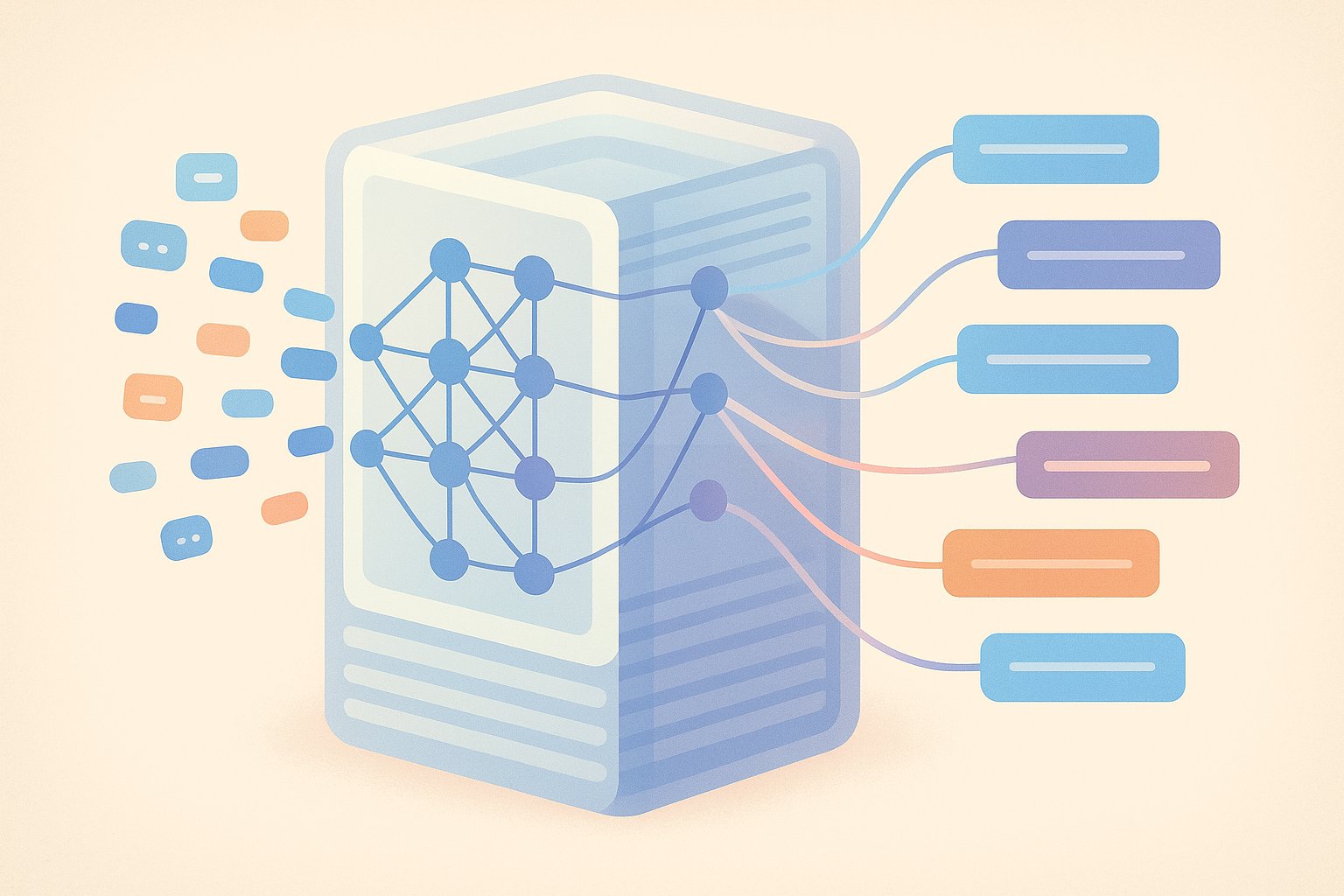
ChatGPT gives the impression that it understands language almost like a human. It answers questions, summarizes texts, writes emails, fixes code, and sometimes even jokes better than some people on the company chat. No wonder many people ask themselves: how does it actually work?
The good news is that you don’t need to study computer science or wade through formulas to understand the basics. A few simple concepts and sensible comparisons are enough. Let’s start from the beginning.
The shortest answer: ChatGPT predicts the next word
That sounds suspiciously modest, but in essence that is exactly the core of how large language models, or LLMs (Large Language Models), work.
ChatGPT takes the text you type, breaks it into smaller pieces, and based on an enormous number of examples from training, predicts what should come next. Then it does it again. And again. Word by word, or more precisely: token by token.
If you type:
“The capital of France is…”
the model will consider “Paris” a very likely next word.
If you type:
“Write a polite email asking to reschedule a meeting”
the model doesn’t “think” like a human about calendars, relationships, and etiquette. Instead, it predicts a sequence of words that best fits that request, based on patterns it learned earlier.
That may seem unromantic, but this simple mechanism is the source of a surprisingly large amount of “intelligent” behavior.
Before the transformer: what is a neural network anyway?
To understand ChatGPT, it helps to first get comfortable with the concept of a neural network.
The name sounds biological, but it’s not a digital copy of the human brain. It’s more like a mathematical system for detecting patterns. Such a system takes input data, processes it through many layers, and produces an output at the end.
You can compare it to several filters placed one after another:
- the first filter catches simple features,
- the next combines them into more complex patterns,
- the next recognizes an even higher level of meaning.
In images, a network may first detect edges, then shapes, and finally conclude: “this looks like a cat.”
In language, it works differently, but the principle is similar: the model learns relationships between elements of text. For example, that after the word “day,” “good” often appears, and that emails usually end after “best regards.”
LLM, or large language model
ChatGPT belongs to the family of large language models. “Large” here means several things at once:
- the model has a very large number of parameters,
- it was trained on very large text datasets,
- it can perform many language-related tasks.
Parameters are, in simplified terms, the numbers inside the model that determine how strongly different elements influence one another. During training, the model adjusts these numbers so it can predict the next pieces of text more accurately.
You don’t need to know the exact math to grasp the idea: the model reads huge amounts of text and gradually gets better at guessing how language usually works.
It doesn’t learn like a student memorizing a definition from a textbook. It’s more like someone who has read an unimaginable amount and, as a result, can sense style, structure, relationships, and typical responses.
For the model, text is not words but tokens
Here comes the first important detail. ChatGPT doesn’t work directly with “words” the way we see them. Instead, it uses tokens.
A token is a piece of text. Sometimes it’s a whole word, sometimes part of a word, and sometimes a single character or punctuation mark.
For example, the sentence:
“I like coffee with milk.”
may be split into smaller parts. The model therefore doesn’t look at text like a human reading a sentence, but like a system operating on a sequence of elements.
Why all this? Because language is too complex to treat every possible word as a separate, rigid block. Thanks to tokens, the model handles:
- new words,
- inflection,
- typos,
- different languages,
- proper names and specialized vocabulary.
It’s a bit like LEGO bricks: with smaller pieces, you can build far more than with ready-made, indivisible blocks.
How does the model “know” what words mean?
It doesn’t know in the human sense. Instead of dictionary meanings, the model builds numerical representations of words and tokens. In practice, each token is converted into a set of numbers that reflects its relationships with other tokens.
That sounds dry, but the effect is interesting. Tokens used in similar contexts begin to have similar representations. This allows the model to “sense” that words like “dog” and “cat” are more similar to each other than “dog” and “microwave.” Fortunately.
That’s why LLMs can:
- recognize the meaning of statements,
- paraphrase sentences,
- translate between languages,
- answer questions in different styles.
Not because they have an encyclopedia in their head in the classic sense, but because they learned statistical patterns in language on a massive scale.
The problem with older models: memory was too short
Before transformers appeared, other architectures were used for text, especially sequential models such as RNNs or LSTMs. Their main problem was quite human: they lost context, especially when the text got longer.
Imagine the sentence:
“The cat, which I saw yesterday at my neighbor’s place, despite the rain and all the commotion, ran into the garden because it got scared by a dog.”
To understand the ending properly, you need to remember who was running and what they were scared of. Older models processed text more step by step, which made it harder for them to maintain relationships between distant parts.
And then the hero of this article enters the stage.
What is a transformer?
A transformer is a neural network architecture designed specifically for working with sequences such as text. It was described in 2017 in the famous research paper “Attention Is All You Need.”
Its biggest breakthrough was that the model doesn’t have to read text strictly word by word like someone moving a finger along a line. Instead, it can look at many elements at once and assess which parts matter to one another.
The key mechanism here is attention.
Attention: what the model pays attention to
This is the most important part of the whole story.
When a person reads a sentence, they don’t treat all words equally. If you see the sentence:
“Ala didn’t go to work because she was sick.”
the word “sick” connects in your mind to Ala, not to work. For us, that’s obvious. For the model, a mechanism had to be created to help capture such relationships.
The attention mechanism allows the model to assess which earlier tokens it should look at when processing the current fragment.
In other words, the model asks itself:
- which words in this sentence are most important right now,
- what is this token connected to,
- where is the needed context.
Thanks to this, ChatGPT better understands relationships such as:
- who is the subject of the sentence,
- what a pronoun refers to,
- which word changes the meaning of another,
- what the topic was a few sentences earlier.
A simple example of attention in action
Let’s take the sentence:
“Maria gave Anna the book because she had already read it.”
A human usually understands that “it” refers to the book, not Anna. The model has to arrive at the same conclusion somehow.
The attention mechanism means that when analyzing the words “it” and “read,” the model can assign greater weight to the word “book” than to other elements of the sentence.
It doesn’t do this through “understanding” in a philosophical sense, but by calculating which elements are most relevant in the given context.
It’s a bit like reading with a highlighter that automatically suggests what’s worth looking at again.
Why the transformer was such a breakthrough
There are several reasons.
First, the transformer handles long-range dependencies better. If an important word appeared much earlier, the model can still “look back” at it.
Second, the transformer enables more parallel processing of data. That matters technically because it speeds up training on huge text datasets.
Third, the architecture turned out to be exceptionally scalable. As people increased:
- the amount of data,
- computing power,
- the number of parameters,
models began doing things that had previously seemed surprisingly difficult: meaningful conversations, summaries, translations, code generation, and answering questions across many fields.
In short: the transformer wasn’t just a small improvement. It changed the rules of the game.
How is ChatGPT trained?
In very simplified terms, this can be divided into two stages.
1. Pretraining on a huge amount of text
First, the model is given a lot of text and learns to predict the next tokens. So again: it sees a fragment and tries to guess what should come next.
If it’s wrong, its parameters are slightly adjusted. This process is repeated an unimaginable number of times.
This is the stage where the model learns:
- grammar,
- writing styles,
- basic facts about the world,
- typical sentence structures,
- relationships between concepts.
2. Fine-tuning for conversation
A model that predicts the next token is not enough on its own. To make it useful as a chat interface, it has to be further fine-tuned.
In practice, that means teaching the model how to respond:
- more helpfully,
- more safely,
- more clearly,
- in line with the user’s intent.
This uses, among other things, examples prepared by humans and feedback about which responses are better.
Thanks to this, ChatGPT doesn’t just “continue text” — it does so in a form that feels like a conversation with an assistant.
Does ChatGPT understand what it says?
This is one of the most interesting questions, and the honest answer is: it depends on what we mean by “understand.”
If by understanding we mean human consciousness, intentions, experience of the world, emotions, and common sense built through life, then no. ChatGPT doesn’t have those things.
But if by understanding we mean the ability to:
- grasp the meaning of a statement,
- recognize relationships between concepts,
- generate a relevant answer,
- apply knowledge in new contexts,
then in a practical sense the model can do a great deal.
That’s why it sometimes seems almost “thinking,” even though its mechanism is based on prediction and statistical patterns, not human experience.
Where do errors and hallucinations come from?
If the model is so good, why does it sometimes state falsehoods with admirable confidence?
Because ChatGPT doesn’t have a built-in truth meter. Its goal is to generate an answer that fits the context and looks plausible. That is not the same as an answer that is always consistent with reality.
Errors can result from several causes:
- the model saw conflicting or incomplete information during training,
- the question is ambiguous,
- the topic requires up-to-date data the model may not have,
- the model “stitches together” an answer from probable elements that sound good together but are not correct.
This is often called a hallucination.
In practice, it’s best to treat ChatGPT as a very capable assistant for thinking and writing, but not as an infallible source of revealed truth.
Why does ChatGPT sound so natural?
Because it was trained on enormous amounts of text written by humans. As a result, it learned:
- the rhythm of language,
- typical sentence structures,
- different writing styles,
- ways of explaining things,
- polite forms and conversational conventions.
The model doesn’t “have a personality” in the human sense, but it can imitate very well the way people formulate responses. That creates a sense of naturalness.
Sometimes almost too much. That’s why it’s easy to forget that there isn’t a person on the other side with a coffee mug, but a system predicting the next tokens with impressive accuracy.
And where do prompts fit into all this?
A prompt is simply the input instruction, meaning what you type into the model. Prompt quality matters a lot, because the model responds to the context you provide.
If you write:
“Tell me about transformers”
you’ll get a general answer.
If you write:
“Explain how transformer architecture works to someone without a technical background, use simple examples, and avoid math”
the answer will usually be much better tailored.
It’s a bit like asking an expert a question. The more clearly you define what you want, for whom, and in what form, the better the chance of a good answer.
If you want to go one level deeper
If after this article you feel that “now it finally makes sense,” but you want to move from general understanding to practice, it’s worth learning further in a structured way. A good next step is a course that shows not only what AI and LLMs are, but also how to use them sensibly at work and in learning.
At Akademia AI, you’ll find materials explained in simple language, without unnecessary technical fluff. This is especially useful for people who want to understand the basics and immediately turn them into practical use, instead of drowning in theory after the second paragraph.
What’s worth remembering from all this
ChatGPT doesn’t work like a magic ball or a digital human locked in a server room. It is a large language model based on the transformer architecture, which learned to predict the next elements of text from a huge number of examples.
The most important pieces of the puzzle are:
- a neural network, meaning a system that detects patterns,
- tokens, meaning the text fragments the model works on,
- training, during which the model learns to predict what comes next,
- attention, meaning the mechanism that focuses on important parts of the context,
- the transformer, which made it possible to process language effectively at scale.
And that may be the most interesting thing of all: behind a tool that looks like a conversation stands a set of ideas that are surprisingly simple in concept. The hard part is the scale, not the core idea itself.
The next time ChatGPT writes you an email, explains a concept, or helps organize your notes, you can remember one thing: it doesn’t “think” like a human. But thanks to the transformer, it can very effectively predict what a sensible answer should look like. And that is enough to do things that, until recently, seemed like science fiction.