Digital Self-Defense 2026: Deepfake, Voice Scam, and 5 Tests
AI can now clone a loved one’s voice, fake a video, and write a message that sounds almost too convincing. This guide shows how to recognize deepfake, voice scam, and phishing, and how simple rules can protect your family and business from an expensive mistake.
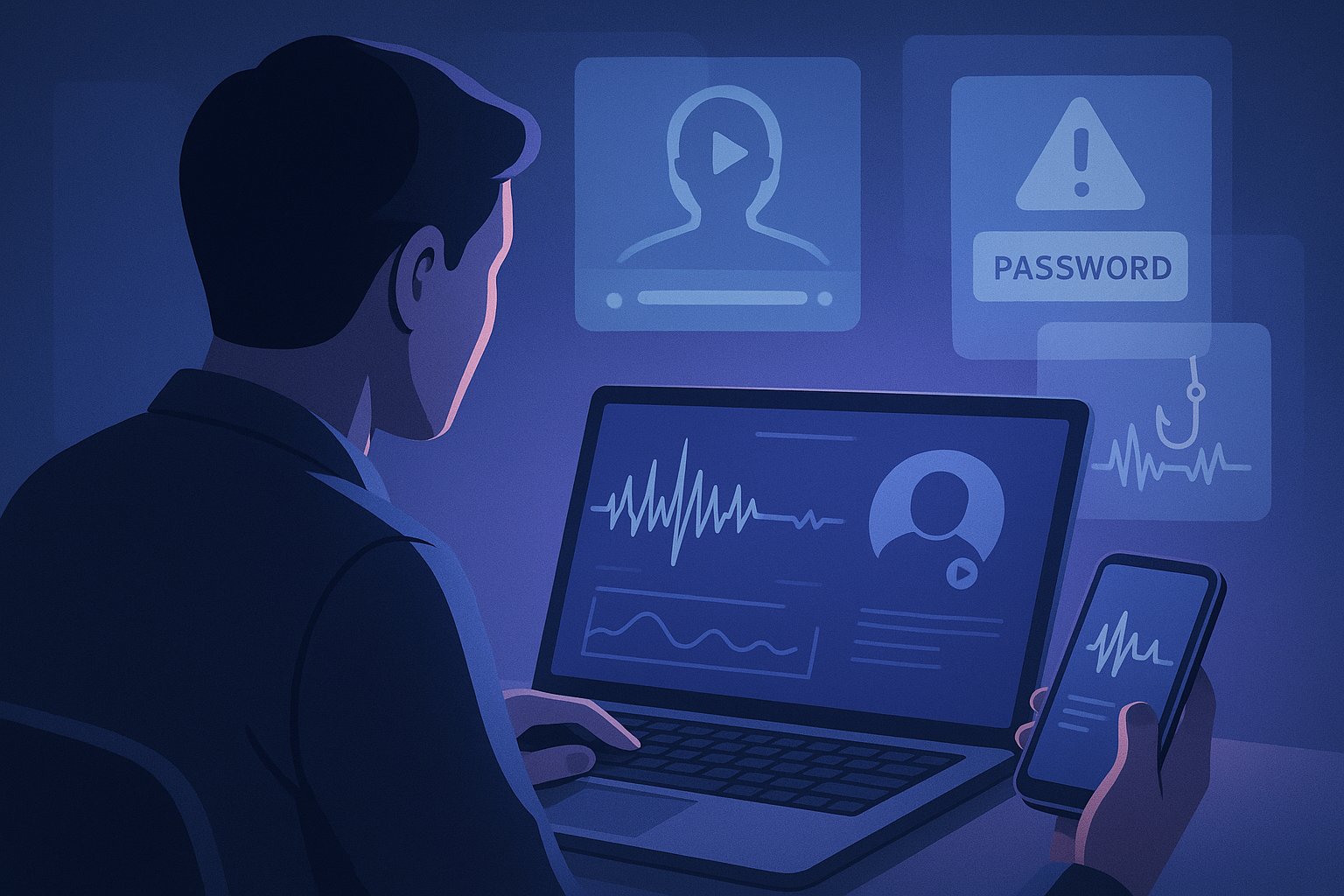
AI cloned a grandson’s voice — and 95% of people fell for it. Sounds like a tabloid headline? Unfortunately, it’s no longer science fiction, but everyday digital self-defense.
The scheme is simple. The phone rings in the evening. In the receiver you hear a panicked voice: “Grandma, I had an accident,” or “Dad, I lost my phone, I’m texting from a new number, send BLIK quickly.” The voice sounds familiar. Emotions take over. Common sense takes a short break. And that’s exactly what scammers are counting on.
In 2026, it’s no longer enough to watch out for “weird emails from a prince in Nigeria.” Threats are smarter, more personal, and often powered by AI tools. The good news? You can still defend against them effectively. You don’t need to be an IT specialist or a cybercrime investigator. You just need to know a few simple rules and apply them at home and at work.
This text is for two groups that increasingly face the same problem: parents 40+, who want to protect themselves and their loved ones, and owners of small and medium-sized businesses, who know that one bad click can cost more than a new laptop.
Why deepfake and voice scam work so well
Because they attack not technology, but the human being.
The scammer no longer has to write a perfect email. It’s enough to trigger urgency, fear, or a sense of duty. AI gives them new tools:
- voice cloning based on a short audio sample,
- video forgery with a face and facial expressions,
- messages written in a specific person’s style,
- phishing automation on a larger scale.
A few years ago, a fake recording was fairly easy to spot: metallic voice, unnatural pauses, strange lip movements. Today it can be much better. Good enough that many people have no suspicions — especially when the message arrives at the right moment.
A real-life example? A business owner receives a voice message supposedly from a partner: “I’m on the road, can’t talk, send that urgent transfer today.” The voice matches. The tone too. The amount isn’t absurd, so nothing sets off a red flag. The problem is that the partner is actually in a meeting and didn’t record anything.
In families it looks similar. “Mom, don’t call now, I have a problem, I need 2,000.” And that’s it. No need to break passwords if you can break vigilance.
Three most common threats worth knowing
1. Video deepfake
This is a fabricated recording in which someone looks and speaks like a real person. It can be a celebrity, a boss, an employee, a child, a grandchild. Sometimes the goal is to steal money, sometimes disinformation, and sometimes simply to “lull vigilance” before the next stage of the attack.
The most common scenario: you receive a video or join a video call where the “boss” asks for urgent action. Poor connection quality, bad lighting, and time pressure do the rest.
2. Voice scam, or voice-based fraud
Today this is one of the most devious tricks. The scammer gets a voice sample from TikTok, YouTube, a Facebook reel, a voice message, or a company webinar. Then they generate speech that sounds like a loved one or coworker.
It doesn’t have to be perfect. It just has to be similar enough, and the conversation has to be short and emotional.
3. AI-assisted phishing
Phishing didn’t disappear. It just matured. Messages are better written, more personal, and harder to distinguish from real ones. Instead of “Dear Customer,” you get your name, your company name, context from a recent order, or an invoice that “almost matches.”
This is especially dangerous in small businesses, where one person handles several areas at once: accounting, purchasing, customer contact, and putting out fires. In that chaos, it’s easy to click “confirm” because, after all, “we need to close this quickly.”
5 simple tests worth doing every time
You don’t need to analyze pixels like a special effects expert. In most situations, a simple set of checks is enough. It’s best to treat it like a home safety reflex — something between checking whether the door is locked and glancing to see whether the iron was turned off.
1. The urgency test: who is telling you to act immediately?
If someone demands an immediate response — a transfer, a code, a link click, a password change — stop for 60 seconds.
Scams almost always run on one fuel: time pressure.
Ask yourself three questions:
- Can this really not wait 10 minutes?
- Does this person usually communicate this way?
- Is the request unusual, even if it sounds plausible?
Example: “I’m at the airport, send BLIK quickly.” It sounds dramatic, and that’s exactly why you need to slow down. A real loved one will survive an extra 3 minutes of verification. The scammer is counting on you not doing it.
2. The second-channel test: call back or message elsewhere
This is the simplest and most effective method.
If you receive a suspicious voice message, SMS, or email:
- don’t reply in the same thread if you have doubts,
- call a previously known number,
- message through an agreed channel, e.g. WhatsApp, Signal, Teams,
- in a company, confirm the instruction through a second person.
If your “son” texts from a new number, call the old one. If your “boss” sends an unusual request by email, confirm it by phone or on the company chat. It’s banal, but banal things are what save budgets.
3. The private-question test: ask something AI can’t guess
When you suspect voice cloning, don’t ask: “Is that you?” That question doesn’t help. Ask a short question that only that person or family would know the answer to.
For example:
- “What was the name of our childhood dog?”
- “Where were we last Christmas?”
- “What code word did we agree on for situations like this?”
In families, it’s worth setting up a security code. One word or short phrase that isn’t obvious and doesn’t appear publicly online. Not “kitty123,” but something like “green compass” or “Tuesday without cheese.” A bit absurd, but that’s exactly why it works.
4. The technical-detail test: look for small inconsistencies
Deepfake and voice scam often pass at the level of overall impression. They stumble on details.
In video, pay attention to:
- unnatural blinking or lack of it,
- mismatch between lip movement and sound,
- strange teeth, tongue, facial edges,
- skin that is too smooth or “floating” facial features,
- lack of consistency in light and shadows.
In voice, listen for:
- unusual sentence rhythm,
- emotions that are too even,
- strange pauses and accents,
- lack of natural fillers characteristic of that person.
The point is not to turn into a forensic lab. The point is a simple thought: if something feels even slightly off, don’t make a transfer just because it “seems to match.”
5. The money-and-data test: treat every unusual request as suspicious
This is a rule that works at home and in business.
Any request for:
- a transfer,
- a BLIK code,
- login credentials,
- a document scan,
- a change of account number,
- opening an attachment labeled “urgent, invoice,”
should trigger a verification procedure.
In a company, it’s best to establish a simple policy: no changes to payments or data without confirmation through a second channel. No exceptions. Even if the owner asks. Especially if the owner asks, because that’s exactly who scammers most often impersonate.
How to protect your family: a few rules that really work
A family doesn’t need a lecture on cybersecurity. It needs simple habits.
First, talk about the fact that a voice on the phone is no longer proof of identity. This is especially important for older parents and grandparents, who often trust what they hear.
Second, establish the previously mentioned security password. One for the closest family members is enough. If someone calls with an “urgent request,” the password comes first.
Third, introduce the rule: we never send money under pressure without confirmation. Even if the situation sounds dramatic.
Fourth, limit the amount of public voice samples and private information online. It’s not about disappearing from the internet, just a bit of common sense. If you publish a lot of videos, recordings, and family details, you give scammers more material to work with.
Fifth, show your loved ones two or three examples of scams. Not to scare them, but to make the mechanism familiar. Once someone sees how it works, it’s harder to surprise them.
How to protect a business without a big IT department
Small businesses are attractive targets because they often have real money, but fewer procedures than corporations. The good news: you don’t need to build a cyber fortress right away.
A few practical rules are enough.
1. Dual authorization for payments
Any unusual payment, account change, or urgent transfer should be confirmed by a second person or through a second channel.
2. A clear procedure for “urgent requests from the boss”
If an employee receives a message with time pressure, they must confirm it by phone or in person. Without feeling like they are “causing a problem.”
3. Training with examples, not definitions
People remember situations: a fake courier email, a partner’s cloned voice, an invoice with one changed account number. Dry theory usually loses to everyday rush.
4. Managers must follow the same rules
If the business owner sends chaotic messages like “make the transfer quickly, I’ll explain later,” they are effectively training the team to comply with scammers. The procedure must apply to everyone.
5. MFA and access hygiene
Multi-factor authentication won’t stop every scam, but it significantly reduces risk after a password is compromised. Add regular access reviews and minimum privileges wherever possible.
Real scenarios: what an attack looks like in practice
Family scenario
A daughter posts lots of reels and stories on Instagram. Her voice is easy to access. Mom answers the phone: “Mom, I can’t talk now, I have a problem, send 1,500 zł, I’ll pay you back soon.” The voice sounds similar, there’s stress, the connection crackles a bit. Mom is already opening the banking app.
What saves her? One rule: first I call back on the old number. It turns out the daughter is at the hairdresser, and the only crisis concerns the length of her bangs.
Business scenario
An accountant receives an email from a “regular supplier” saying the account number on invoices has changed. The email looks good, the signature matches, the language is correct. This is no longer phishing with meme-generator-level mistakes. It’s a polished message.
What saves the company? A procedure: any account change requires phone confirmation using the number from the contract, not from the email. One call and the matter is clear — the supplier changed nothing.
Video-call scenario
An employee gets an invitation to a short online meeting. On the other side is the “director,” the image is a bit poor, and they speak briefly and directly: a document must be downloaded urgently and client data sent because “the board is waiting.”
What should raise the alarm? Low quality, pressure, an unusual request, and no standard path of action. That’s what many effective scams look like: not perfect, just convincing enough to bypass vigilance.
Where people confuse caution with panic
In digital self-defense, the goal is not to suspect everyone and fear every phone call. The goal is to distinguish trust from automation.
That’s a big difference.
You can trust loved ones and coworkers while still verifying unusual requests. You can use AI, social media, and messengers without sending your common sense on vacation.
The biggest mistake? Thinking: “This doesn’t concern me” or “I wouldn’t fall for it.” In practice, the easiest people to fool are not those who know the least, but those who are tired, busy, and convinced they have everything under control.
It’s worth practicing this beforehand, not after the fact
If you want to better understand how AI works in practice — including the risks, automation, and everyday uses — a good step is to organize that knowledge in one place. For parents, entrepreneurs, and people who work with information every day, it makes simple sense: it’s easier to recognize a threat when you know what AI tools can really do and what they can’t.
That’s why it’s worth checking out the AI Academy trainings. This kind of learning is useful not only “for working with technology,” but also for ordinary, practical digital self-defense: from assessing content credibility to safe habits in communication and work.
Minimum plan for the next week
You don’t need a revolution. It’s enough to implement a few things right away:
- agree on a family security code,
- tell your loved ones that a voice and phone number are not proof of identity today,
- in your company, introduce the rule of confirming unusual payments through a second channel,
- turn on MFA wherever it’s still missing,
- remind the team: time pressure is not an argument, it’s a warning sign.
These are not spectacular moves. But they are the ones that most often stop a scam before it has a chance to gain momentum.
Digital self-defense starts with one reflex
Not with expensive software. Not with expert jargon. With a short question: how do I know this is really that person?
If you teach this to yourself, your family, and your team, you’ll do more than most. Because in a world of deepfakes, voice cloning, and phishing, the winner is not the one who knows the most technical terms, but the one who can pause emotion for a moment and check the facts.
And sometimes those 60 seconds decide whether it ends as a strange story to tell at dinner, or as a transfer you’d very much like to reverse.