AI-Native Development Platforms: the new standard for building software
AI-native platforms are no longer just a curiosity for teams that like experimenting. More and more often, they are becoming a practical working environment for developers, technical leaders, and startups that want to build faster, cheaper, and smarter. What is changing, where are the real benefits, and what should you watch out for before enthusiasm turns into technical chaos?
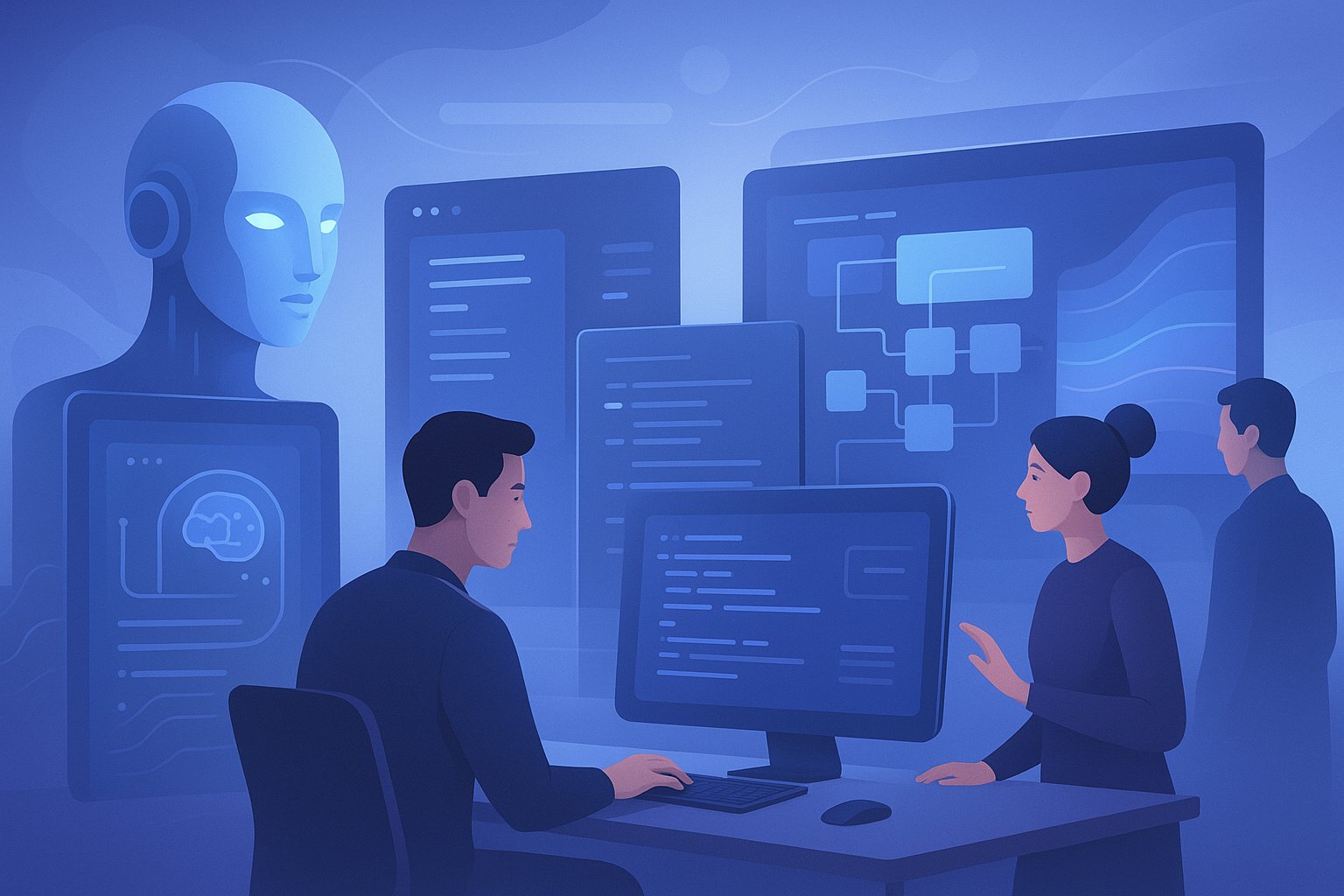
Still just a platform, or already a new way of working?
For years, tools for programmers evolved in a fairly predictable way. A better code editor, more efficient CI/CD, more convenient hosting, more automation around testing and monitoring. Each of these layers improved something, but the core of team work remained similar: a human designs, writes code, stitches together integrations, fixes bugs, and only at the end checks whether the business actually got what it asked for.
AI-native development platforms change not only the pace of work. They change the very way software is created. AI is not an add-on here in the style of “suggest a variable name” or “write a unit test.” It becomes part of the process architecture: from requirements analysis, through code generation and refactoring, to testing, documentation, observability, and maintenance.
That is an important difference. When AI is a “plugin,” it usually helps in isolated ways. When a platform is AI-native, the entire environment assumes collaboration between humans and models as the default mode of operation.
For developers, that means less mechanical work. For technical leaders, new ways to scale a team. For startups, a shorter path from idea to working product. But also a few pitfalls it is better to know about before the first costly implementation.
What exactly is an AI-native platform?
Simply put: it is a software development environment in which AI is not an add-on, but one of the core operating mechanisms.
In practice, such a platform usually offers:
- generation of fragments or entire application components based on a description of the goal,
- understanding of project context — architecture, repository, dependencies, coding style,
- support in solution design, not just in writing syntax,
- automatic creation of tests, documentation, and migrations,
- assistance with debugging and refactoring,
- integration with the development pipeline: repositories, CI/CD, observability, issue tracking,
- work at the level of intent, not only low-level instructions.
Sounds ambitious? Because it is. But that is exactly why we are talking about a change in standard, not another trend with a nice landing page.
What makes AI-native different from “AI for code”
Many teams already use programming assistants. That is a good start, but it is not the same thing.
Classic AI coding tools mainly help locally:
- complete a function,
- suggest syntax,
- generate simple boilerplate,
- sometimes summarize a file or explain an error.
AI-native platforms go further. They operate on a broader context and support the entire delivery cycle. Instead of answering the question “how do I write this method?”, they help answer the question “what is the best way to deliver this feature to production, while maintaining quality and a sensible architecture?”
It is a bit like the difference between a calculator and a good analyst. Both are useful, but only one of them understands why you are calculating in the first place.
Why this model is gaining ground now
There are several reasons, and none of them comes down to hype alone.
First, models are simply better. They understand code, business context, and dependencies between components more effectively. They still make mistakes, sometimes surprisingly creative ones, but their usefulness has stopped being an experiment in the “cool hackathon toy” category.
Second, companies are under pressure to deliver faster. Roadmaps are not getting shorter, budgets are not growing infinitely, and hiring senior engineers still does not feel like shopping at the local corner store.
Third, system complexity is growing. Microservices, event-driven architecture, cloud, security policies, compliance, integrations with external APIs — all of this means that a large part of team work is no longer about “writing features,” but about managing complexity. AI-native platforms help tame that complexity.
Fourth, startups need leverage. If a small team can operate like a larger one, the advantage becomes very concrete. It is not about replacing people, but about increasing throughput without proportionally increasing costs.
What work looks like in an AI-native model
Let’s imagine a simple scenario. A team is building a user onboarding module for a SaaS application.
In a traditional model, the process often looks like this:
- The PM describes the requirements.
- The tech lead breaks down the tasks.
- The developer implements the backend and frontend.
- Someone adds tests.
- Someone else updates the documentation.
- QA reports regressions.
- In sprint review, it turns out the edge-case logic was not thought through well enough.
In an AI-native model, some of these stages can be supported or accelerated by the platform:
- from the requirement description, a proposed architecture and component breakdown is created,
- AI generates endpoint skeletons, validation, data models, and basic tests,
- the tool points out inconsistencies between the API contract and the frontend,
- technical documentation updates in parallel,
- during code review, AI catches some issues before they reach a human,
- after deployment, the platform helps analyze logs, errors, and potential regressions.
The developer is still needed. Very much so. The difference is that their role shifts from executor of repetitive tasks toward operator of the software production system, designer, and quality controller of decisions.
This is not a cosmetic change. It is a competency shift.
The biggest benefits for developers
For programmers, the most valuable thing is not simply “writing faster.” You can also write a mess faster, and no sensible person wants that.
The real benefits are more practical.
Less boilerplate, more meaningful problem solving
Manually creating CRUDs, validation, basic tests, mappers, configuration, or API documentation is not the height of intellectual entertainment. AI-native platforms can take over a significant part of that work.
The result? More time for decisions that really matter:
- how to simplify the domain,
- where to draw responsibility boundaries,
- how to reduce technical debt,
- how to design a system resilient to change.
Better onboarding to the project
A new person on the team usually needs time to understand the code, dependencies, and unwritten rules. AI-native platforms can act as a translation layer for the project: they explain the repository structure, relationships between modules, and the impact of changes.
This shortens ramp-up time and reduces the number of questions like “why does this service do this in three places at once?” Although, to be fair, sometimes the answer is: “because the project history was turbulent.”
Faster iterations
If generating the first version of a solution takes minutes instead of hours, it becomes easier to test variants. And that matters enormously for product experiments, prototypes, and features with uncertain ROI.
What technical leaders gain
Tech leads and engineering managers look at the topic a bit differently. For them, scale, predictability, and quality are key.
Higher productivity without simply adding headcount
Not every gap in the roadmap can be filled by hiring. Sometimes it is not even worth trying. An AI-native platform can increase team efficiency without immediately expanding headcount.
This is especially important where:
- the backlog grows faster than the team,
- senior engineers are overloaded with mentoring and reviews,
- several products need to be maintained at once,
- the company is under pressure from investors or the market.
More consistent standards
A well-implemented platform can reinforce team standards: coding style, architectural patterns, security policies, and the way changes are documented. It will not replace engineering culture, but it can support it.
Better visibility into risks
If AI helps analyze PRs, dependencies, test gaps, or the potential impact of changes, a leader can see more quickly where the project is starting to drift. And early detection of a problem is usually cheaper than later “putting out production fires.”
Why startups are so eager to look this way
A startup does not need a perfect process. It needs a process that lets it quickly verify whether the product makes sense. That is exactly why the AI-native model is so attractive for young companies.
A small team can:
- build an MVP faster,
- iterate on features more cheaply,
- reduce time spent on low-value technical tasks,
- maintain a larger product scope without immediately growing the team.
That does not mean AI solves all startup problems. It will not fix weak product-market fit, it will not replace customer conversations, and it will not magically make a rushed architecture elegant. But it can buy something very valuable: time and optionality.
And at an early stage, that is often a more important currency than perfection.
Where the limitations and risks are
This is where we need to come back down to earth. AI-native platforms make sense, but they are not free of problems.
Hallucinations and false confidence
A model can generate code that looks convincing and still be wrong, unsafe, or completely incompatible with the architecture. The more a team trusts it without verification, the greater the risk.
Blurred responsibility
If “AI suggested it,” it becomes easy to stop asking who is responsible for the decision. And in engineering, responsibility must be concrete. Someone approves the code, someone accepts the trade-offs, someone takes responsibility for the consequences.
Technical debt generated faster
Yes, that is possible. Speed without control can produce technical debt at a pace that used to require real effort. If a team does not have clear rules for review, testing, and architecture, AI can accelerate not only development, but also chaos.
Security and privacy
Not every organization can freely send code, logs, or data to external models. There are compliance issues, intellectual property concerns, vendor policies, and data processing requirements.
Vendor dependence
The deeper the platform enters the production process, the harder it becomes to replace later. That is classic vendor lock-in, just in a new, more intelligent package.
How to implement AI-native sensibly
The worst possible scenario? Enthusiasm, buying a tool, no rules, and quick disappointment. A better path looks less flashy, but it works.
Start with a concrete use case
Do not implement a platform “for innovation.” Choose an area where the pain is real:
- slow boilerplate creation,
- overloaded code review,
- weak onboarding,
- testing delays,
- documentation problems.
Set boundaries for trust
The team should know:
- what AI may generate automatically,
- what always requires human review,
- what data may be used,
- what security standards apply.
Measure impact, not impression
A mere feeling that “work is more modern now” is not enough. Look at concrete metrics:
- lead time,
- number of regressions,
- onboarding time,
- team throughput,
- documentation quality,
- senior engineer workload.
Treat AI like a junior-plus team member, not an oracle
That is probably the healthiest metaphor. AI can be fast, helpful, and surprisingly sharp. It can also be very confident about things it does not understand. In other words, to put it gently, that is not exactly a foreign trait in the IT industry.
Which skills will really matter now
In the AI-native world, the importance of skills that were not always the most highly valued in the classic development model is growing.
The biggest winners are people who can:
- define the problem precisely,
- evaluate the quality of solutions, not just produce them,
- understand the system architecture as a whole,
- connect the technical and business perspectives,
- design a workflow with AI, not just use a tool.
This is especially important for technical leaders. A team’s advantage will not come only from the number of great coders, but from the quality of the decision-making system around the code.
Learning practical AI use in development
If you want to approach this topic sensibly, it is worth learning not only the tools themselves, but also how to work with them: where they help, where they fail, and how to integrate them into the process without damaging quality.
A good direction is learning on a platform that combines practice with business and technical context. That is why it is worth checking out the AI Academy offer — especially if you are a developer, a technical leader, or building a product in a startup. Instead of another generic presentation, you get a structured approach to working with AI that can be translated into everyday team decisions.
Is AI-native really the new standard?
More and more suggests that it is. Not because every company will immediately abandon its current stack and move development into one “magical” environment. Rather because expectations for the software development process are already changing.
There will be growing pressure to:
- build faster,
- maintain quality despite greater complexity,
- use team knowledge better,
- reduce repetitive work,
- make decisions based on broader context.
AI-native platforms address exactly these needs. They are not perfect. They will not replace engineering thinking. They will not make a bad process good just because a language model was added to it.
But they can become a new working standard where speed, quality, and adaptability matter.
For developers, that is a signal that it is worth developing skills beyond writing code alone. For technical leaders, it means it is time to design teams and processes with human-AI collaboration in mind. For startups, it means the advantage no longer has to come solely from team size, but from how well the team can use new tools.
And if someone still treats AI-native development as a passing trend, it is worth watching the market very carefully. Because it may turn out that the “experiment” is just becoming the default way of building software.